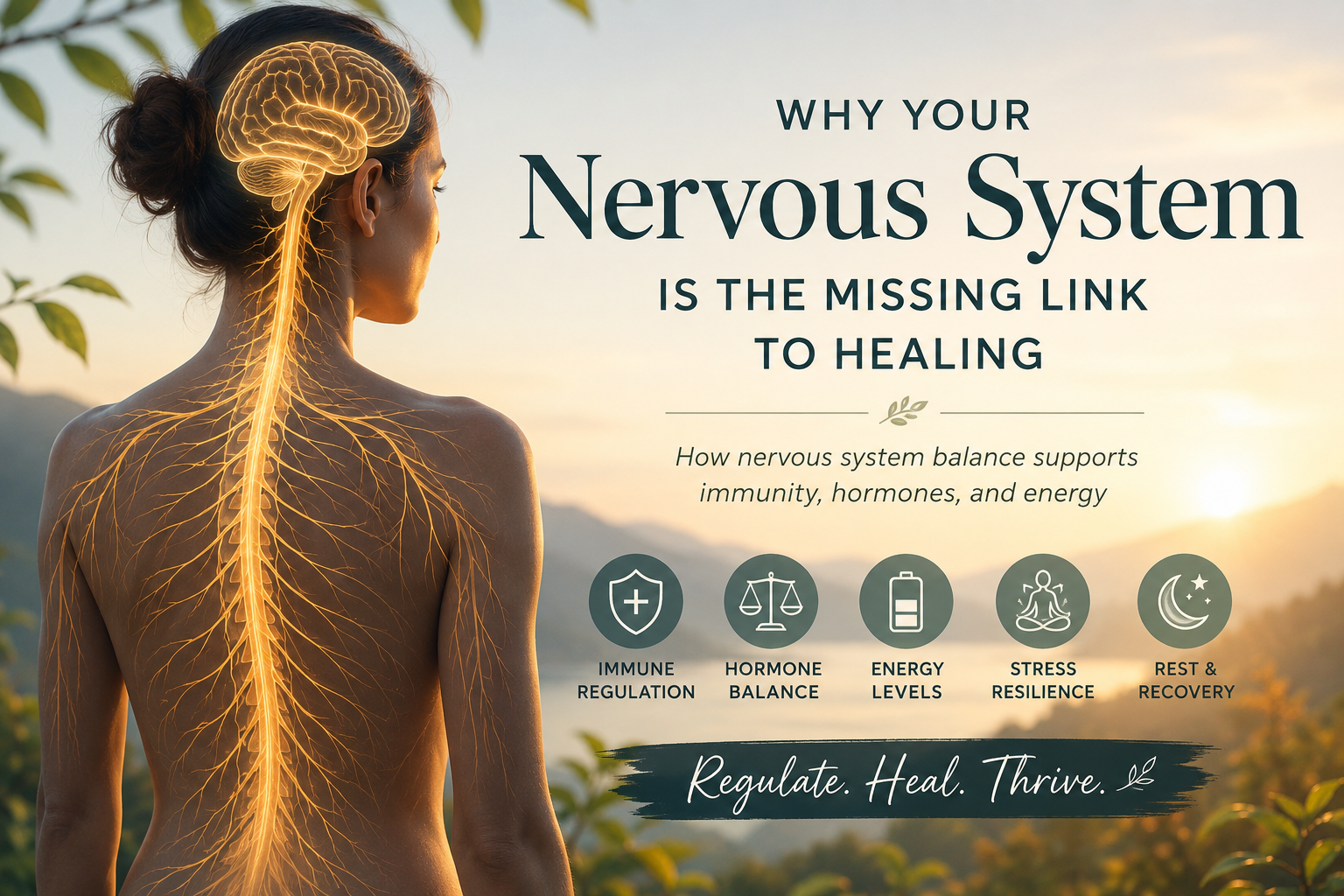
How Neuroplasticity Shapes Your Brain, Stress & Health
Your Nervous System Is Always Adapting..
What if one of the most important things to understand about your health is that your brain is not fixed?
Every day, your nervous system is responding to the world around you. The way you move, breathe, sleep, eat, learn, interact with other people, and respond to challenges all provide information that your brain and body must process. Your nervous system is constantly receiving these inputs, interpreting what they mean, coordinating a response, and adapting based on experience.
This ability to change is called neuroplasticity, and understanding it can completely change the way you think about your brain, your nervous system, and your health.
Your Nervous System Is Your Communication Network
Your nervous system is much more than your brain. It includes your brain and spinal cord, peripheral nerves, sensory systems, autonomic nervous system, and the vast networks communicating with your muscles, organs, and tissues. Together, these systems help you sense what is happening both outside and inside your body, integrate that information, and coordinate an appropriate response.
Touch something hot and your nervous system rapidly organizes a protective response. Stand on an unstable surface and information from your eyes, inner ear, muscles, and joints helps your brain keep you upright. Walk into a stressful meeting and your autonomic nervous system may increase alertness, heart rate, and cardiovascular output. Later, when you are resting in a safe environment, physiology can shift toward processes associated with digestion, restoration, and recovery.
In this way, your nervous system is constantly asking three basic questions: What is happening? What does it mean? What should I do about it?
This is one reason the nervous system provides such a useful framework for understanding human health. It is continuously helping the body perceive its environment, coordinate its behavior, and adapt to changing demands.
What the Science Tells Us: Your Brain Can Change
For much of modern medical history, the adult brain was viewed as relatively fixed. We now know that picture was incomplete. The nervous system retains the ability to modify its function and organization in response to experience. This is what we mean by neuroplasticity.
Neurons can alter the strength of their connections, neural networks can reorganize, and repeated experiences can influence how efficiently particular circuits operate. Learning depends on these processes. So does acquiring a new motor skill, improving balance, learning an instrument, and many forms of neurological rehabilitation.
A simple way to think about it is this: what you repeatedly ask your nervous system to do can influence what it becomes better at doing.
However, neuroplasticity is not automatically positive. The brain adapts to repeated inputs whether those patterns are helpful or unhelpful. Repeated practice can strengthen a useful skill, but repeated behaviors and experiences can also reinforce patterns we may not necessarily want. Plasticity simply means the nervous system is capable of adapting. The more important question is: What are you asking it to adapt to?
Stress Isn't the Enemy
Stress is often discussed as though it is inherently harmful, but the ability to mount a stress response is essential for survival and performance. During situations that require action, the sympathetic branch of the autonomic nervous system helps mobilize resources. Heart rate and cardiovascular output increase, energy becomes more readily available, and attention may sharpen. These responses are useful when you are exercising, competing, giving a presentation, or responding to an actual threat.
Parasympathetic pathways, on the other hand, participate in functions associated with digestion, energy conservation, cardiovascular regulation, and recovery. We need both systems to be balanced and function in harmony.
The goal, therefore, isn't to remain “parasympathetic” all day. A healthier target is adaptability: the ability to appropriately increase activation when the situation requires it and transition toward recovery when that demand has passed.
Instead of thinking sympathetic = bad and parasympathetic = good, think of nervous-system health as the ability to move appropriately between states based on what life requires.
Where the Vagus Nerve Fits In
The vagus nerve has become one of the most talked-about structures in the wellness world, sometimes with claims that go well beyond the available evidence. But its actual biology is fascinating enough without exaggeration.
The vagus nerve, or cranial nerve X, is a major component of parasympathetic communication. It connects the brain with structures throughout the neck, chest, and abdomen and participates in the regulation of cardiovascular, respiratory, and gastrointestinal functions.
Importantly, vagal communication isn't simply the brain sending commands down to the body. A large proportion of vagal fibers are afferent, meaning they carry information from the body toward the brain. This highlights a much larger principle: communication between your brain and body is constantly occurring in both directions.
Your breathing influences physiology. Movement produces enormous amounts of sensory information. The gastrointestinal system communicates with the brain through neural, immune, endocrine, and metabolic pathways. The cardiovascular system continually generates information that the nervous system monitors and responds to.
The brain is not an isolated command center floating above the body. It is part of an extraordinarily dynamic brain-body communication network.
Movement Is Fuel for the Brain
Exercise is not just for your muscles. Every time you move, enormous amounts of sensory information travel through your nervous system. Your brain must determine where your body is in space, where your head is moving, what your eyes are looking at, how much force your muscles need to produce, and how your posture and balance need to change from moment to moment.
Physical activity also appears to influence biological processes associated with neuroplasticity. One of the most studied is brain-derived neurotrophic factor (BDNF), a protein involved in neuronal function, synaptic plasticity, learning, and memory. Human research has found that exercise can influence circulating BDNF, although the magnitude and duration of this response depend on factors such as exercise intensity, duration, population, and measurement timing.
This does not mean that every workout instantly “grows your brain.” It means something more nuanced and useful: movement provides rich neurological input while also influencing biological pathways associated with brain health and adaptation.
Your workout is a brain experience too.
Your Sensory Systems Help Build Your Experience of the World
Movement also highlights how dependent the brain is on sensory information. Your visual, vestibular, and proprioceptive systems continually work together to help you understand where you are and how to move through your environment.
Vision provides information about the world around you and helps guide movement through space. The vestibular system, located within the inner ear and its central connections, detects head movement and orientation relative to gravity and contributes to balance, posture, spatial orientation, and gaze stabilization. Proprioceptive information from muscles, tendons, joints, and related sensory receptors helps the nervous system estimate body position and movement.
Your brain continuously integrates these streams of information rather than relying on any one system in isolation. Try standing on one leg and then closing your eyes. The task usually becomes more difficult because you have removed one of the major sensory inputs your brain was using to maintain balance.
That simple experiment gives you a glimpse of something your nervous system does every second of every day: combine multiple streams of information to create an appropriate response.
Sleep Is Part of the Neuroplasticity Process
If movement and experience provide information to the nervous system, sleep helps the brain process experience.
Sleep is not a period in which your brain simply shuts down. Research has linked sleep with learning, memory consolidation, synaptic plasticity, metabolic regulation, and many other aspects of brain function. Across different stages of sleep, neural networks demonstrate complex patterns of activity associated with processing and reorganizing information acquired during wakefulness.
A useful way to think about this is that your waking life provides experiences for the brain to work with, while sleep participates in how some of those experiences are processed and consolidated.
This is one reason sacrificing sleep in the name of productivity can eventually become counterproductive. If you care about learning, performance, recovery, or long-term brain health, sleep isn't wasted time. It is an essential part of the adaptation process.
Your Environment Is Training Your Nervous System
This is where neuroscience becomes practical. You aren't only “training your brain” when you perform a brain exercise. You're training it through the repeated experiences of everyday life.
Consider the information your nervous system receives during a typical day: natural daylight or artificial light, movement or prolonged sitting, face-to-face interaction or constant notifications, time outdoors or hours of screen exposure, novel challenges or repetitive routines, periods of stress followed by recovery—or stress followed immediately by more stress.
None of these inputs need to be viewed as inherently good or bad in isolation. Human beings are remarkably adaptable, and one stressful day or poor night of sleep does not define your health. What matters more are the patterns that accumulate over time.
One night of poor sleep is very different from chronically sleeping too little. One sedentary afternoon is different from years without regular physical activity. A difficult week is different from prolonged stress without adequate opportunities for recovery.
Health is rarely determined by a single input. Your repeated patterns matter.
Five Ways to Support Your Brain + Nervous System
Supporting your nervous system doesn't require turning your life into an elaborate biohacking experiment. Some of the most powerful starting points are also the most fundamental: movement, sleep, breathing, learning, and recovery.
First, move your body regularly. Walk, lift weights, run, hike, dance, play sports, and incorporate activities that challenge coordination and balance. Physical activity supports cardiovascular and metabolic health while also providing the nervous system with rich sensory and motor input.
Second, protect your sleep. Maintain a reasonably consistent sleep-wake schedule, seek natural light during the day, reduce unnecessary stimulation late at night, and give yourself adequate opportunity to sleep. Your brain needs periods of both experience and recovery.
Third, experiment with slow, comfortable breathing. Breathing is unusual because it operates automatically but can also be voluntarily controlled. Changing respiratory rate and pattern can influence cardiovascular and autonomic physiology. One simple practice is to inhale gently through the nose for approximately four seconds and exhale slowly for approximately six seconds for two to five minutes. This isn't about “hacking” the vagus nerve. It's simply one accessible way of intentionally influencing your physiological state.
Fourth, challenge your brain. Learn a skill, practice a new movement, play an instrument, learn a language, work on your balance, try a new sport, or expose yourself to appropriately difficult problems. Neuroplasticity depends on experience, and the nervous system needs meaningful challenge in order to adapt.
Finally, build genuine periods of recovery into your life. Spend time outside. Walk without your phone. Read. Meditate. Pray. Stretch. Spend time with people you care about. Recovery does not have to be complicated. Sometimes it simply means giving your nervous system fewer demands to respond to.
The Weekly Reset
Knowing neuroscience is interesting. Using it is what matters.
This week, don't try to completely optimize your life. Instead, give your nervous system a few consistent inputs. Spend ten minutes learning or practicing something new. Move your body intentionally every day. Get outside and expose yourself to natural daylight, particularly earlier in the day when possible. Spend two to five minutes practicing comfortable slow breathing. Finally, choose a realistic bedtime and protect it.
These behaviors aren't magic, and no single practice determines your health. Their value comes from repetition. Small inputs, repeated consistently, become part of the environment to which your nervous system adapts.
So rather than asking, “What health hack am I missing?”, consider asking:
“What information am I repeatedly giving my brain and body?”
The Big Idea
Your brain isn't simply something you were born with and carry unchanged throughout life. It is a dynamic organ that continues responding to experience. Your nervous system is constantly sensing, integrating, responding, learning, and adapting.
Movement matters. Sleep matters. Challenge matters. Recovery matters. Your sensory environment matters. The people and experiences surrounding you matter.
You cannot control every input life throws at you, nor should you try. But you can become more intentional about many of the inputs you repeatedly provide.
Your brain is always adapting. The question is: What are you training it to adapt to?
Ready for Your Next Reset?
If you want a simple place to start, download my free Nervous System Reset for practical strategies you can incorporate into your day through movement, breathing, and recovery—without turning your health into another full-time job.
Join The Weekly Reset for evidence-informed ideas about the brain, nervous system, development, nutrition, and human performance delivered straight to your inbox.
Research + Further Reading
Knaepen K, et al. Neuroplasticity—exercise-induced response of peripheral brain-derived neurotrophic factor: a systematic review of experimental studies in human subjects. Sports Medicine. 2010.
El-Sayes J, et al. Effects of Physical Exercise on Neuroplasticity and Brain Function: A Systematic Review in Human and Animal Studies.
Yang G, et al. Experience and sleep-dependent synaptic plasticity: from structure to activity. Philosophical Transactions of the Royal Society B. 2020.
Abel T, et al. Sleep, plasticity and memory from molecules to whole-brain networks. Current Biology.
Disclaimer: This article is for educational purposes only and is not intended to diagnose, treat, cure, or prevent disease or replace individualized medical care.
Yours in Health,
Dr. Austin Tchikatilov
The Weekly Reset